

Most students prepare for the first JEE exam only thinking that the same strategy will work in the second examination. However, after clearing the initial stage, they do realise that the final exam needs a fully different mindset and focus. If you got confused about JEE Main vs JEE Advanced, you’re not the only one in this. This guide will explore the massive difference between JEE Main and JEE Advanced and also clarify the JEE Main and Advanced eligibility and explain how to shift your study plan for IITs.
JEE Main vs JEE Advanced: Comparison Table
|
Factors |
JEE Mains |
JEE Advanced |
|
Conducting Body |
NTA |
One of IITs |
|
Purpose |
IIIT/NIT/GFTI Admission |
IIT Admission |
|
Eligibility |
Class 12 pass |
Top 2.5L in Main |
|
Attempts |
2 every year, 3 years |
2 consecutive years |
|
Question Types |
Numericals, MCQs |
MCQs, Match, Integer |
|
Difficulty |
Moderate Level |
Higher Level |
What Is the Real Difference Between JEE Main and JEE Advanced?
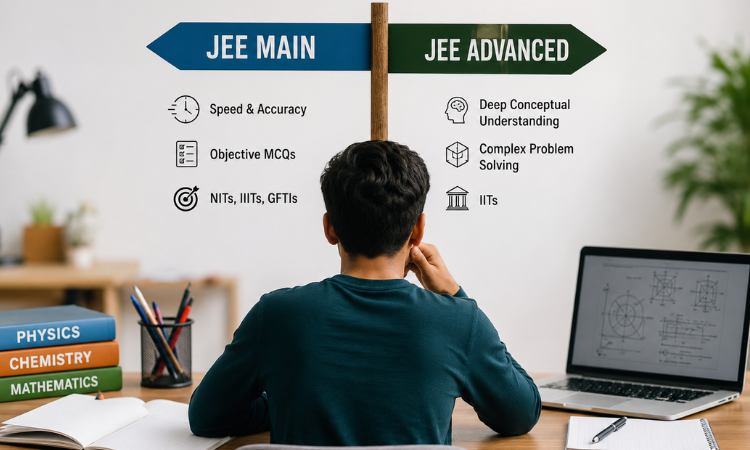
The major JEE Main vs JEE Advanced difference is for the thinking required. The main rewards are accuracy, speed and quicker recall, often testing the concept of time. Advanced tests towards deep analytical thinking, thus combining multiple concepts for a single problem.
For instance, a major question that might ask for the velocity for a block towards a smoother incline. An advanced question that will give a rough incline, a variable force and a spring for the maximum compression. This can explain the JEE Main vs JEE Advanced difficulty gap.
Same Syllabus, Different Level of Questions
Is the JEE advanced harder than Main? Yes, here’s the JEE Main vs JEE Advanced difficulty:
|
Factors |
Mains |
Advanced |
|
Conceptuals |
Moderate |
Very High |
|
Speed Required |
High |
Moderate |
|
Problem Solving |
Moderate |
Very High |
|
Time Pressure |
High |
Moderate |
|
Guesswork |
Low |
Very Low |
Mains that have a high time pressure for solving the moderate questions quickly. Advancing in the lower time pressure for extreme, high conceptual depth. You can guess through the advanced, each step that requires logical proof.
How Your Preparation Strategy Should Change
Your JEE Main vs Advanced preparation that can evolve:
Before Main
Focus on NCERT, building speed and solving PYQs (Previous Year Questions). Along with self-study, many students also seek guidance through an online tutoring platform to improve conceptual understanding and stay consistent with their preparation. Taking time for mocking to occur and securing the NIT backup.
Between Main and Advanced
Shifting focus from speeding to depth. Solve those multi-concept problems and advanced PYQs. Analysis mocks deeply; maintain the error log and practise time management for complicated questions.
Final Month
Focus on the revision for the error log and practising time management for weaker topics and improvement towards the standard materials. Solve the integer type for creating the analytical mindset.
Common Mistakes Students Make
- Treating advanced for the harder main: Trying to solve the advanced questions for multi-level speed leads towards panic.
- Solving too many simple questions: This builds a false confidence for the analytical muscle needed that is for advanced.
- Ignoring mock analysis: Taking tests without any kind of mistakes is a waste of time.
- Memorisation instead of understanding: Rote learning that can fail completely for advanced learners.
- Poor time management: Relaxed too much for the main causes for problem-solving momentum.
- Ignoring negative marking: Just by blindly guessing in MCQs can actually destroy the overall rank. Just read your MCQ options carefully and mark accordingly.
Avoiding these kinds of mistakes is important for success. Instead of rushing, take a step back and fully evaluate your studying plan. Do focus on aspects like deeper learning and also maintaining an error log to help in mock tests and more. Do stay sharp until the last paper. Consistency plus self-awareness can outperform that blind hard work.
Myth vs Reality
Myth: The highly advanced syllabus is completely different.
Reality: The JEE Main vs JEE Advanced syllabus is largely the same, and only the depth changes.
Myth: A high mains percentile that guarantees IIT admission
Reality: IIT admission depends on your JEE advanced rank.
Myth: One big coaching centre that cracks advanced.
Reality: Proper guidance, consistent self-study, plus regular mock tests are being effective.
FAQs
Is JEE Main compulsory for JEE Advanced?
Yes, this is important and compulsory. You need to qualify for the first exam and secure the rank for the top 2.5 lakh candidates to become eligible to appear for the advanced-level examination.
Is the syllabus different?
The core topics that are the same. However, the JEE Main vs Advanced syllabus can differ significantly for the depth of the question, whereas the main examination is for the advanced paper.
Which exam is more difficult?
The advanced exam that’s difficult overall. This tests deep analytical thinking plus multi-concept application, whereas the main examination focuses just on accuracy, speed and direct concept application.
How many attempts are allowed?
You can attempt the main exam twice a year for consecutive years. The advanced exam can be attempted with a maximum of 2 lines for consecutive years, starting in the 12th grade.
Can I prepare for both together?
Yes, you can easily prepare for both simultaneously. Focus towards creating that strong fundamental list, then slowly increase the difficulty level for the practice questions as those advanced exam approaches.
How should I switch from main to advanced preparation?
Move your focus of study from speed to conceptual focus. Start solving previous years' advanced papers and analysing the mistakes deeply, and practise the multi-concept problems instead of those direct formula-based questions.
Key Takeaways
- JEE Mains qualifies you for the top IITs/NITs, while the JEE Advanced can select you for IITs.
- Both share the same syllabus but require different thinking styles.
- Your preparation strategy will shift from going for speed to being accurate for those deep problem-solving questions.
- Understanding the JEE Main vs JEE Advanced difficulty can help you plan better.
- Ultimately, the right quality of practice matters a lot more than the quality of questions solved.
Do understand that cracking these examinations is not for raw intelligence; this is about having great consistency plus having the right kind of mindset to crack advanced ones. Avoid those common traps of having multiple reference books. Just stick to your core materials and revise regularly and trust the process. Also, take care of physical and mental health, as burnout is an actual challenge during that intense journey. Keep your goals super clear and crystal clear and always stay focused towards cracking the exam while still working hard for the exam. With the best guidance plus disciplined study hours, you can have a positive attitude and achieve your dream of cracking JEE Advanced.